
Understanding 'Allah' as the Divine Name: A Study of Its Linguistic Roots and Cultural Context
Keywords:
Al-Ilah , Allah, Arabic root , Divine name, Etymology, Semitic languagesAbstract
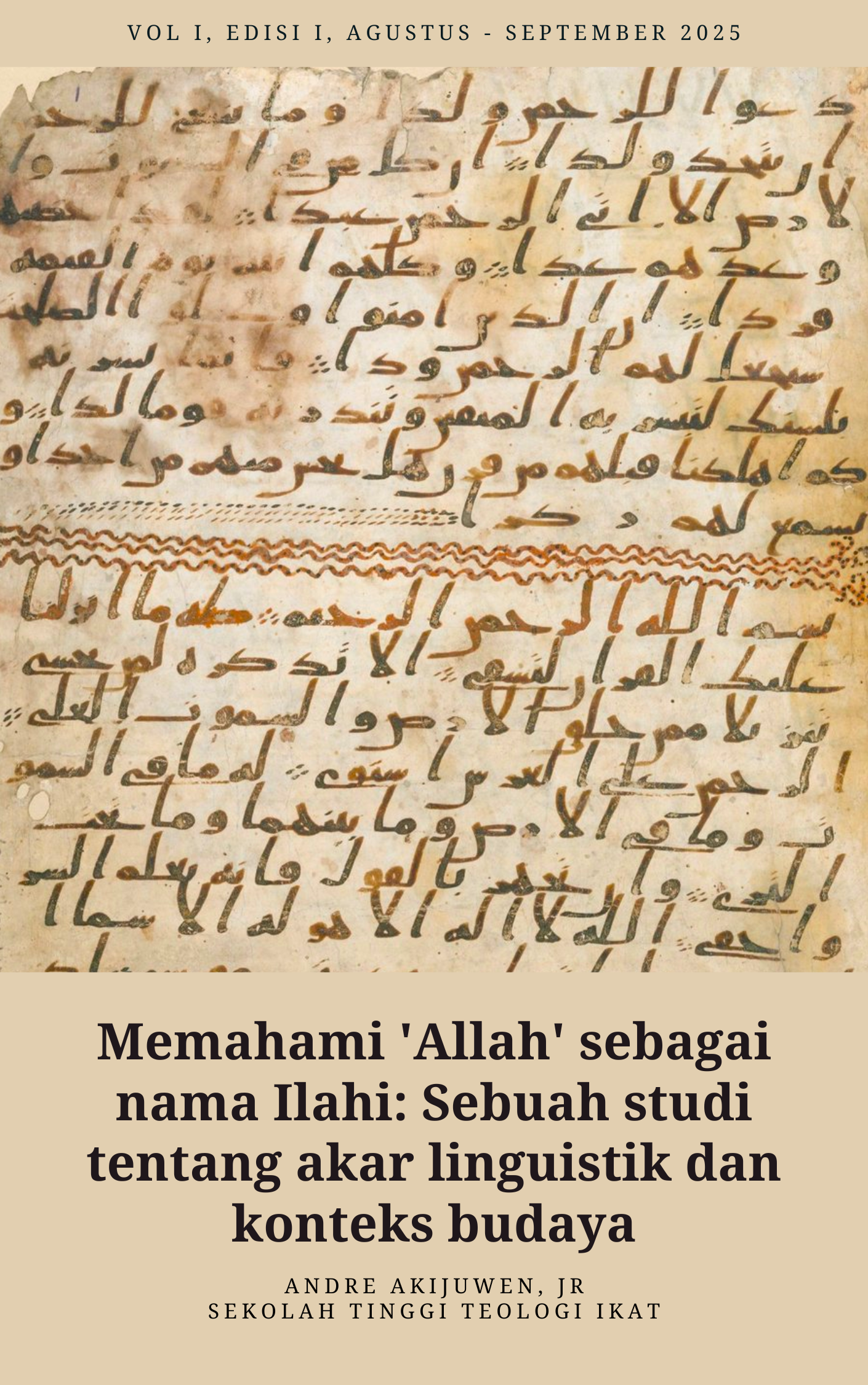
This study explores the linguistic, theological, and cultural significance of the term "Allah" in Islamic and non-Islamic contexts, focusing on its usage in Indonesia. The term "Allah" is universally recognized as the name of God in Islam. Still, its use in other religious communities, especially among Arabic-speaking Christians, presents complex interfaith and cultural dynamics. This research addresses the ambiguity surrounding "Allah" and its role in religious identity, interreligious dialogue, and social harmony.
The study adopts a multi-method approach, combining linguistic analysis, historical investigation, qualitative interviews, and case studies. The research begins with a linguistic and historical analysis of "Allah" to trace its evolution from pre-Islamic Arabia to its central role in Islamic theology. Interviews with religious leaders and community members from Muslim and Christian backgrounds in Indonesia are conducted to gain insights into how "Allah" is perceived and used in daily spiritual practices. The study also includes case studies from different regions of Indonesia to examine local attitudes and the impact of "Allah" on interfaith relations.
The findings reveal that while "Allah" is central to Islamic belief, its usage in Christian communities, particularly in Arabic-speaking regions, reflects its linguistic roots rather than theological alignment. In Indonesia, the term "Allah" plays a significant role in shaping religious and cultural identity, but its shared use between Muslims and Christians leads to varying interpretations and potential conflicts. Regional differences in accepting "Allah" highlight the complexity of its use in a multireligious society. The study concludes that "Allah" serves as a unifying linguistic marker and a source of tension, depending on its perception in different social and religious contexts.
This research provides valuable insights into the role of language in religious identity and interfaith dialogue, offering a nuanced understanding of how "Allah" functions in Indonesia's pluralistic society. The findings contribute to ongoing discussions on religious tolerance and cultural integration in Indonesia.
Downloads
Downloads
Published
Issue
Section
License
Copyright (c) 2025 Phos Φ

This work is licensed under a Creative Commons Attribution 4.0 International License.
License Terms
The work published in this journal is licensed under the Creative Commons Attribution-NonCommercial-ShareAlike 4.0 International License (CC BY-NC-SA 4.0). This means that:
-
Attribution (BY): You are free to share, copy, redistribute, remix, adapt, and build upon the material in any medium or format, for noncommercial purposes only, as long as you give appropriate credit to the original author(s), provide a link to the license, and indicate if changes were made.
-
Non-Commercial Use (NC): You may not use the material for commercial purposes. Commercial use means the material is not primarily intended for or directed towards commercial advantage or monetary compensation.
-
ShareAlike (SA): If you modify, remix, or adapt the material, you must license the modified material under identical terms, meaning that your adaptations must also be licensed under the same Creative Commons license (CC BY-NC-SA 4.0).
-
Non-Exclusivity: The author retains the right to use the work in other publications, presentations, or personal use, provided proper attribution is given.
-
No Additional Restrictions: You may not apply legal terms or technological measures that legally restrict others from doing anything the license permits.
-
Licensor: The original author(s) of the work are the licensor(s), who grant you the rights outlined in this license.
-
License Link: For more information on the terms of this license, please visit Creative Commons


