
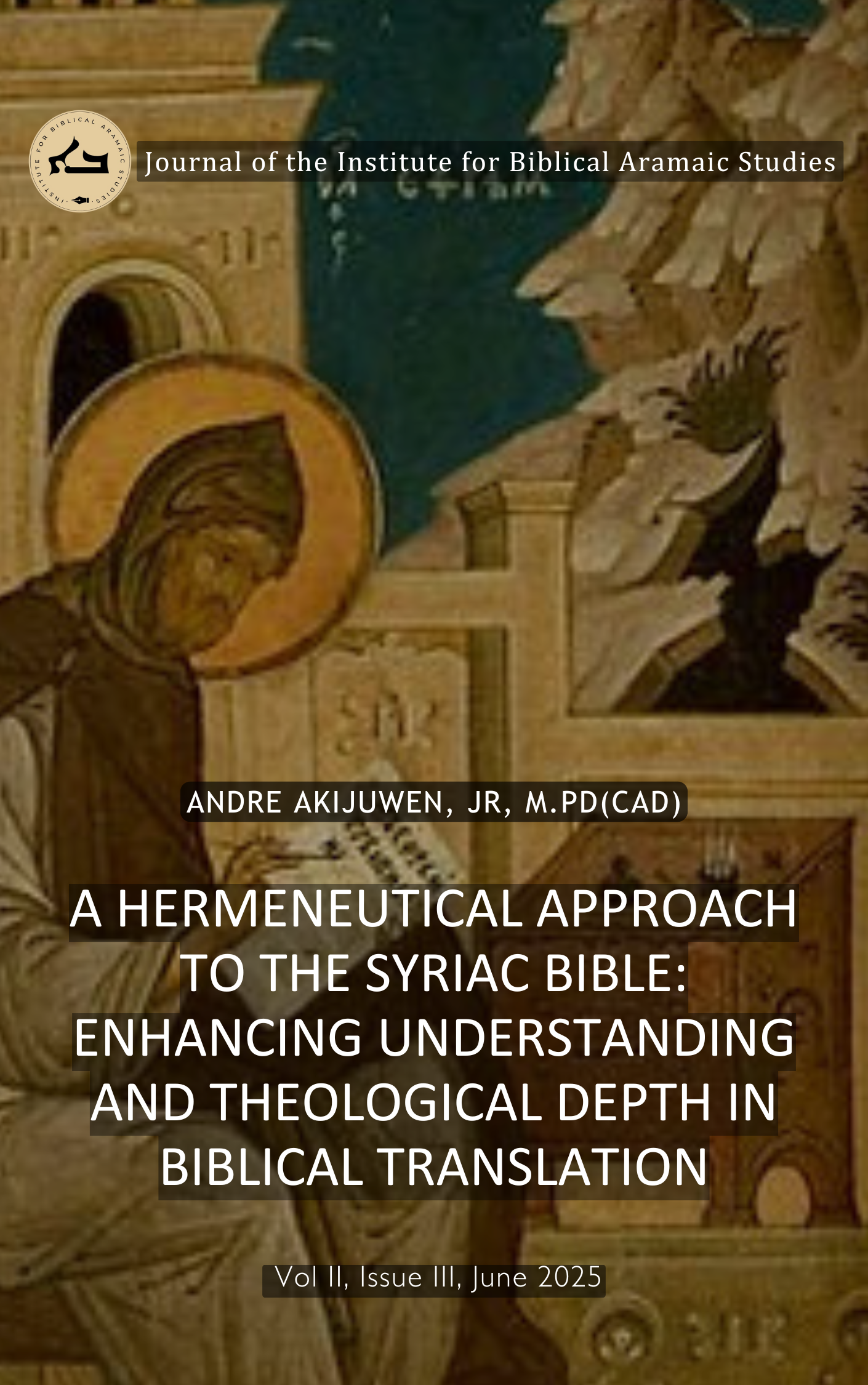
A hermeneutical approach to the Syriac Bible: Enhancing understanding and theological depth in biblical translation
Keywords:
Biblical Translation, Hermeneutical Approach, Peshitta, Syriac Bible, Theological DepthAbstract
This paper explores the significance of a hermeneutical approach to the Syriac Bible, particularly focusing on its impact on biblical translation and theological depth. The study examines how Syriac-Aramaic plays a crucial role in transmitting and interpreting biblical texts, highlighting its unique contribution to understanding key theological concepts, especially in comparison to Greek and Hebrew texts. The paper discusses how the Syriac tradition emphasizes communal salvation, Christology, and the Kingdom through a detailed analysis of the Peshitta and its translation methods. God. It offers richer theological insights that often remain hidden in more traditional translations. Methodologically, the paper employs a comparative analysis of Syriac-Aramaic texts, particularly the Peshitta, with Greek and Hebrew translations, emphasizing how linguistic and cultural nuances shape theological interpretations. The conclusion underscores the potential of Syriac-Aramaic hermeneutics to fill gaps in modern biblical scholarship, promoting a more holistic and inclusive approach to scriptural interpretation. This hermeneutical framework enriches our understanding of early Christian thought and enhances the depth and relevance of contemporary biblical translations.
Downloads
Downloads
Published
Issue
Section
License
Copyright (c) 2025 Syriac and Aramaic Studies Review

This work is licensed under a Creative Commons Attribution 4.0 International License.
License Terms
The work published in this journal is licensed under the Creative Commons Attribution-NonCommercial-ShareAlike 4.0 International License (CC BY-NC-SA 4.0). This means that:
-
Attribution (BY): You are free to share, copy, redistribute, remix, adapt, and build upon the material in any medium or format, for noncommercial purposes only, as long as you give appropriate credit to the original author(s), provide a link to the license, and indicate if changes were made.
-
Non-Commercial Use (NC): You may not use the material for commercial purposes. Commercial use means the material is not primarily intended for or directed towards commercial advantage or monetary compensation.
-
ShareAlike (SA): If you modify, remix, or adapt the material, you must license the modified material under identical terms, meaning that your adaptations must also be licensed under the same Creative Commons license (CC BY-NC-SA 4.0).
-
Non-Exclusivity: The author retains the right to use the work in other publications, presentations, or personal use, provided proper attribution is given.
-
No Additional Restrictions: You may not apply legal terms or technological measures that legally restrict others from doing anything the license permits.
-
Licensor: The original author(s) of the work are the licensor(s), who grant you the rights outlined in this license.
-
License Link: For more information on the terms of this license, please visit Creative Commons


Deprecated: urlencode(): Passing null to parameter #1 ($string) of type string is deprecated in /home/u216208240/domains/journal.ibas.us/public_html/plugins/generic/pflPlugin/PflPlugin.php on line 217
Deprecated: round(): Passing null to parameter #1 ($num) of type int|float is deprecated in /home/u216208240/domains/journal.ibas.us/public_html/plugins/generic/pflPlugin/PflPlugin.php on line 311


